Room4More
The Built4More Newsletter
On growth, change, and what coaching actually is. Signal over noise.
This issueYour certainty was never yours. It came with the job.
In this issue
- 01A comedian whose act ended when a wall came down, and the breakfast he served to seventeen people.
- 02Coaching, decoded: you haven’t lost your nerve. A lease has ended.
- 03Five shows in one week, one landlord, and a list worth making before Friday.

The job ends. The certainty goes back with the keys.
Twice this month I have listened to a very capable person apologise for having lost their nerve. One had left a bank. One had left a country. Neither had lost anything of the kind. Something that was never theirs had been handed back, and nobody had told them it was on loan.
Tony Robbins gave it a name in September, and then, in a single week in October, four other shows found the same thing without hearing him. This issue is about the lease. And about the smaller, slower certainty that does not come with keys, which is the only kind that was ever yours.
— Philippe
The act ended. He wasn’t in the room.
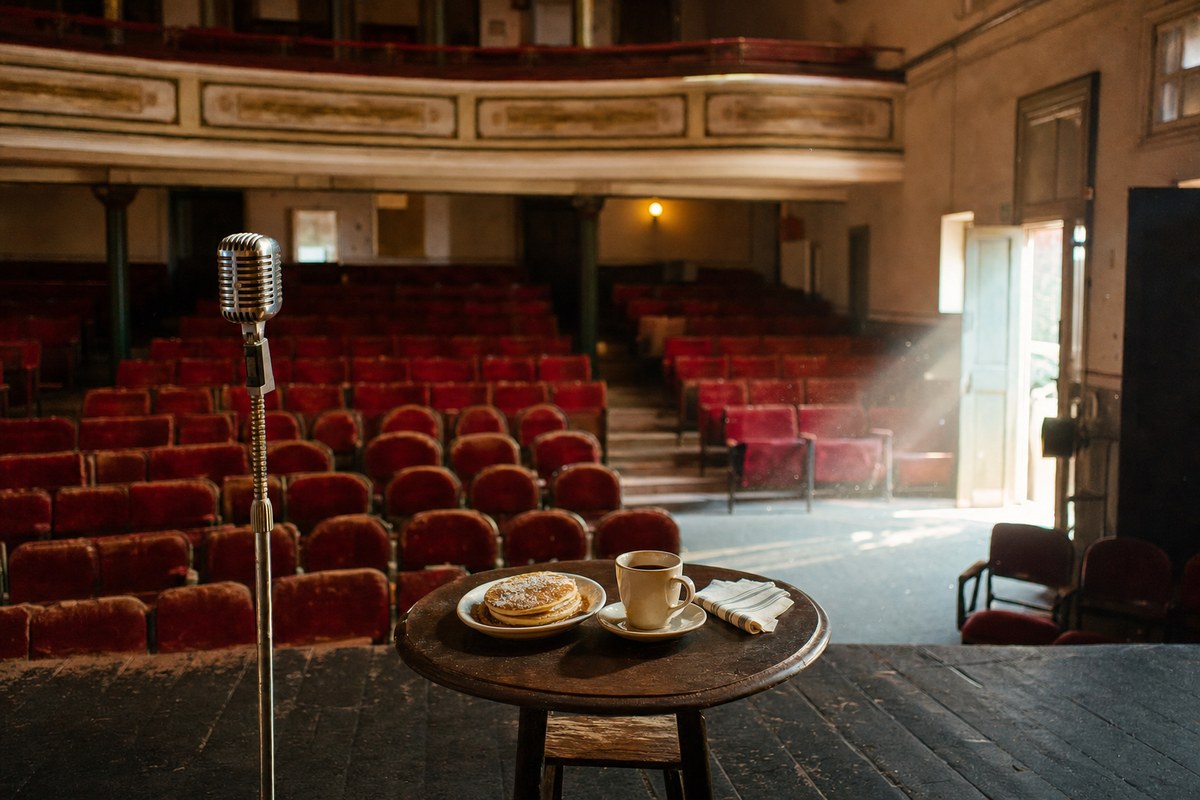
Yakov Smirnoff built an act on one premise: a Soviet émigré marvelling at America. What a country. It filled rooms in Las Vegas, Reno, Atlantic City and Lake Tahoe for most of a decade. Then the Soviet Union came apart, and within six months none of those contracts was renewed. No scandal. Nobody had stopped liking him. The premise had simply stopped existing.
“I was helping Reagan to chisel the wall down, but there was a writing on the wall that I didn’t see. It says, get a day job, you know, and I didn’t see it.”
Yakov Smirnoff · The Joe Rogan Experience #2557 · 23 September 2026Consider what had been holding him up. His timing was his. His material was his. The certainty that the material would land was not. It belonged to the Cold War, and the Cold War ended without consulting him.
On a tip from Willie Nelson he went to Branson, Missouri, in 1993, and opened to seventeen people. He served them his mother’s breakfast in the showroom. Over the years that followed he built it into a theatre of two thousand seats, and while the theatre grew he went back to school, a master’s in psychology and then a doctorate, flying in for weekend classes, because the collapse had shown him something the Vegas years never asked him to look at.
He is seventy-five now, and he calls the collapse a gift:
“I think that I look back and I’m going, thank you for this, because it was kind of a one-note tune.”
Yakov Smirnoff · same conversationNobody plans to find out which parts of their certainty were on loan. The world usually arranges the test. The question this issue is interested in is the one Smirnoff had to answer in a showroom with seventeen plates on the tables: what, exactly, is left when the premise goes?
You haven’t lost your nerve. A lease has ended.
The myth
You used to be a confident person. You decided things in a sentence and walked into rooms as if they were yours. Since the exit, or the move, or the restructure, that person has gone quiet, and you have started to wonder whether they were ever really you.
What’s actually going on
Most of the certainty capable people carry is rented. It comes with the title, the salary, the calendar someone else fills, the name on the door that gets the meeting. It is real, and it works, and you never have to notice where it comes from, because for twenty years it is simply there every morning. When the job goes, that certainty goes back with the keys. That is not a failing of character. It is a lease ending.
The certainty didn’t leave you. It went back with the keys.
Here is what the building was doing while you thought you were doing it. It set the priorities, so the big decisions arrived pre-sorted. It kept the pipeline full, so there was always a next thing. It put a name in front of yours, so the door was open before you reached it. Your competence inside all that was real. It also ran on all that.
Outside, the job changes, and almost nobody is told. Inside an institution, somebody else made the space your work went into. Outside, making the space is the work, and it is a different skill, not a harder version of the old one. The person who was decisive for twenty years and cannot now choose a restaurant has not become indecisive. They are doing a job they were never trained for, in a building that no longer exists.
The harder half is what gets filed where. For twenty years every steady morning went into the file marked character. None of it went into the file marked circumstance. So when the steadiness goes, the mind reaches for the same file and writes a worse entry: I’ve lost it. Both entries are wrong in the same way. The structure was holding more of you than anyone noticed, and you were holding more than the structure ever recorded.
The certainty that is yours is smaller than the rented kind, slower to build, and it has a different source. It does not come from the title. It comes from deciding, finding out, and deciding again. One small decision made with no building behind you, survived, counts. The next one counts more. It is not a feeling that comes back one morning. It is built, one decision at a time, and there is no other way to build it.
Same person · same morning · a different lease
Rented
Certain because of the title.
The building decides what Tuesday is for.
Owned
Certain because you decided.
Tuesday is yours to fill, and you fill it.
From the inside it feels like losing your nerve. It is a lease running out.
Read the lease
Write down five things you were certain about at the height of the last role.
Next to each, one word: whose? If the certainty came with a budget, a team, a title, a diary someone else filled or a name that got you the meeting, write theirs. If it would have survived the car park on your last day, write mine.
You will end up with a shorter list than you hoped. That is the lease, read honestly. The short list is not the bad news. It is the inventory, and it is the only part you can add to.
Five shows, one landlord.
None of them was talking to the others. All of them had found the same lease.
“Most of us have been living with rented certainty. The certainty of what I mean by rented is we’re certain because we have a certain job. We have a certain income.”
Tony Robbins · Modern Wisdom #1153 · 21 September 2026Most of that episode is about something else, and the half-minute that matters is this one. The word is exact. A lease has a landlord, a term and a day the keys go back, and none of those is decided by the tenant.
“When you take away the institution, then the only way you can thrive is if you’re someone who can create that space for yourself.”
Malcolm Gladwell · The Rich Roll Podcast #1017 · 1 October 2026Rich Roll asks why some people flourish after leaving a big institution and others do not, and the answer is structural, not moral. Inside, somebody made the space for you: the priorities, the pipeline, the slot your work went into. Outside, making the space is the job. Nobody who was good at the first job was ever asked to learn the second.
“The decoupling that has to happen is you have to be willing to let go of the identity and the roles in order for something new to emerge.”
Chip Conley · The Tim Ferriss Show #885 · 1 October 2026He ran fifty-two hotels through the dot-com bust and 9/11, sold the company, and spent two years with no title at all before Airbnb called. The ending is his, and he had sold a company first, which paid for the two years. The part that travels is the order: the role goes before the next thing can show up. Most people try it the other way round and wait for the new thing before letting go of the old one. Nothing arrives. The chair is still taken.
“See, it’s not like, oh, we don’t like your product. You’re the product, you know?”
Sylvester Stallone · On Purpose with Jay Shetty · 28 September 2026Asked which was harder, the early rejections or being written off after success, he does not hesitate. Early rejection lands on a plan. Years of success fuse the title with the person, so the later verdict lands on you. That fusing is the lease being signed, and nobody reads it at the time.
“In the desert you find out quickly which of your certainties you packed yourself. The ones the city gave you stay in the city. The ones you walk out with are small, and they are enough.”
Franz KohlerBuilt4More coach · coach, facilitator & explorerBefore
“I ran a division of two hundred people. Eight months after the exit I stood in a supermarket unable to choose between two kinds of rice, and I told nobody.”
After
“I’d been certain for twenty years on the firm’s account. I’m certain about less now, and all of it is in my name. I chose the rice. It was fine.”
Nothing about the person changed. The lease ran out.

“I wasn’t confident. I was employed.”
Said in a second session by someone eleven months out of a bank, who had booked the first one to work on “losing my confidence”. There was a laugh, then a long quiet, and the quiet was the session.
You were good at the job. The job was also good at you.
Both things are true and neither cancels the other. The competence was real: the judgment, the speed, the way a room settled when you spoke. The scaffolding was also real: the pipeline, the priorities, the name that got you the meeting. For twenty years they were so well fitted that nobody, you included, could see where one ended and the other began.
What the first year outside does is separate them, roughly and without asking. That hurts, and it is also the most accurate information you have ever had about yourself. The question was never whether you were good. Only which parts travel.
Keep the competence. Return the keys.

“Children don’t borrow their certainty from a title. They decide, find out and decide again before lunch. Somewhere between then and the corner office we hand that in. It can be asked for back.”
Sandra CaracolBuilt4More coach · emotional therapy & conscious parentingWhat would you still be certain of, if nobody were paying you to be?
Answer it on paper. The list will be shorter than you hoped, and it is the only part that was ever yours.
Hit reply and tell me what you found — even if it is one word. It comes straight to me, and I read every one.
Curious what this looks like for you?
The first conversation is exactly that — a conversation. No pitch, no homework, no framework to memorize. We start where you are and look honestly at what’s in the way.
Start a conversationFour moments we tend to work with. If one of them sounds like where you’re standing, that’s a good place to begin.